
Self-watering planters, and which plants should stay out of one
A look at how a reservoir keeps soil moist without daily topping up, and why that steady damp helps some plants and quietly rots the roots of others.
Read the care guide for your plantHow the wick carries water up to the roots
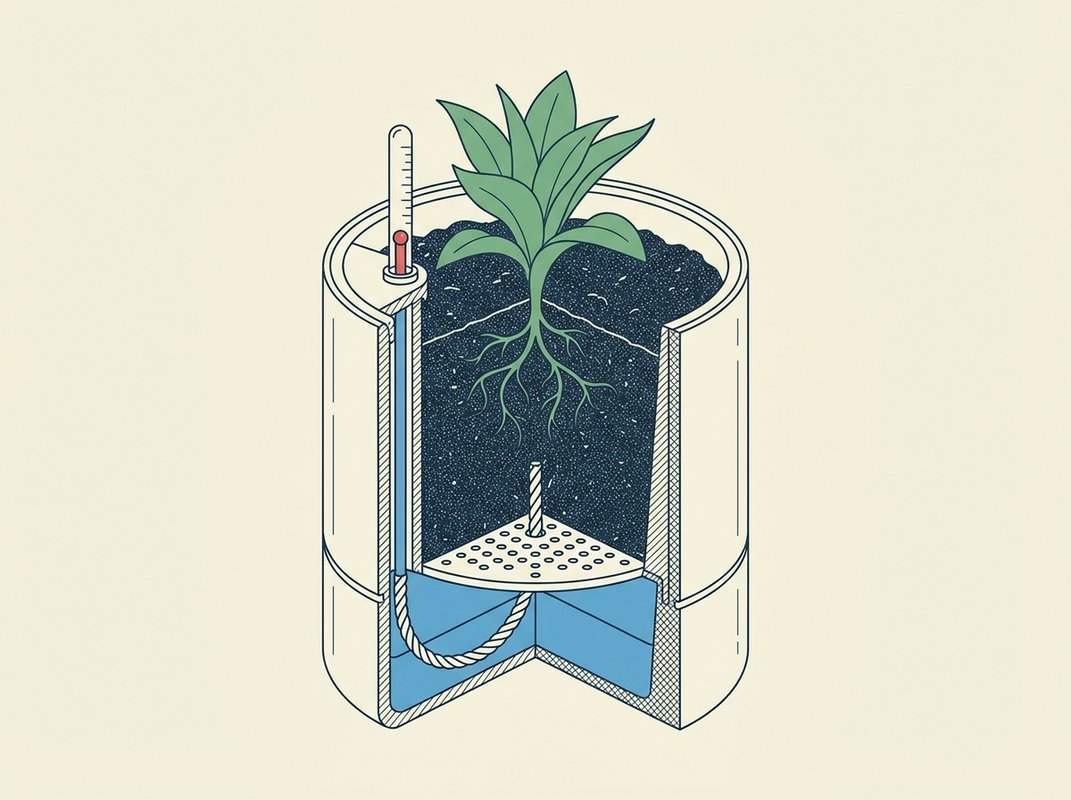
A self-watering planter is built in two parts: an inner pot holding the soil and roots, sitting above a reservoir of water in the base. A wick system connects the two, usually a length of absorbent cord, a fabric strip or a built-in clay cone that runs from the water up into the soil.
The wick works through capillary action, the same effect that pulls a spill up into a paper towel. Water clings more strongly to the narrow fibres of the wick than to itself, so it travels upward against gravity and into the soil close to the roots. As the plant draws moisture from that soil, more is pulled up behind it, so the top of the soil stays evenly damp without the usual cycle of soaking and drying out between waterings.
Most pots sold with this system include some way of checking the reservoir without lifting the inner pot out: a float that rises and falls with the water, or a dipstick marked to show the level. It is worth checking that gauge, because the top can look dry even when the reservoir underneath is still full.
What happens once the reservoir runs dry
Once the water level drops below the wick, capillary action stops. From that point the pot behaves like an ordinary container: the soil dries from the top down, and nothing is replacing the moisture the plant is using. A self-watering planter left dry for a stretch does not fail gently, so refilling it once the indicator reads low keeps the mechanism doing what it is there for.
Which plants actually want constant moisture?
A self-watering pot suits a particular kind of plant: one that wants the soil to stay evenly damp and sulks, visibly, the moment it dries out, but doesn't want to sit in standing water either. That's a narrower group, and worth naming plant by plant.
Peace lilies show the problem most clearly
A peace lily droops within a day or two of the soil drying out, which is exactly the inconsistency a reservoir and wick are built to smooth over. The wick keeps drawing moisture up to the roots between top-ups, so the plant doesn't lurch between damp and dry on a watering schedule that's easy to miss by a day or two in a busy week.
Ferns and calathea want the same steady moisture, without the swings
Ferns and calathea both come from shaded, consistently humid conditions, and both show stress through the leaves: fronds crisping at the edges, calathea leaves curling or browning along the margin. Letting the compost dry out even briefly tends to show up as damage that takes weeks to grow out, so a setup that keeps moisture level suits them.
Beyond these three, the same reasoning applies to other foliage plants from humid, low-light habitats, including the prayer plants that sit close to calathea on the family tree. The test isn't the plant's name so much as its habit: if it wilts dramatically the first time the soil dries past the top couple of centimetres, and recovers just as dramatically once watered, it's a candidate. If it's happier bone dry for a week between waterings, it isn't, whatever else it has in common with the plants above.
Specific watering depths and frequencies for each of these plants, including what the leaf damage looks like before it's permanent, are covered in the peace lily and calathea care guides, and in the room-by-room guidance for the humid spots in a British home, like bathrooms, where ferns and calathea tend to do best.
Which plants should never go in a self-watering pot
A self-watering planter works by keeping a reservoir of water in the base of the pot, which feeds the soil from below for days at a time through a wick system (a cord or fibre that draws water up by capillary action). That suits a plant that wants its soil kept evenly moist, but it is the wrong setup for a plant whose roots need to dry out completely between waterings.
Why succulents, cacti and snake plants suffer in one
Succulents, cacti and snake plants store their own water in thick leaves and roots, and in their native conditions the soil around them drains fast and dries out fully before the next rain falls. Put those roots in soil that never dries below the surface and they cannot get the air they need. The tissue turns soft and dark and the rot spreads upward from the base. Yellowing or wilting leaves are often the last sign to show, well after the damage below the soil has started.
What to give these plants instead
A pot with a drainage hole, a gritty or free-draining mix, and a proper dry spell between waterings suits succulents, cacti and snake plants far better than a reservoir that keeps the roots wet around the clock. A standard terracotta or plastic pot, watered only once the soil has dried out completely, does the job a self-watering insert cannot. The succulent and cactus care guide and the snake plant care guide set out the watering rhythm and pot setup that actually work for them.
What to check before buying a self-watering planter
Before you hand over money for a self-watering planter, there are three things worth looking at that decide whether it actually saves you watering trips or just adds a reservoir you never quite trust. None of them are obvious from a product photo, so it helps to know what to check.
Reservoir size relative to pot volume
A reservoir only buys you time in proportion to how much soil it is feeding. A small water chamber tucked under a large pot of soil might stretch your watering interval by a day or two. Look for the reservoir's stated volume in litres and weigh it against the pot's own volume, the same litres-versus-diameter figure covered on the planter size guide. A reservoir that is a small fraction of the pot's soil volume is doing very little beyond a normal saucer.
Material
Self-watering inserts are mostly moulded plastic, which is light and holds water without losing it through the walls, but the outer pot can be plastic, glazed ceramic or terracotta built around a plastic liner. Terracotta's porous walls pull moisture out of the soil as it dries, which works against the point of a reservoir system, so a self-watering pot in unglazed terracotta is fighting itself. A quick read of the full rundown on planter materials makes it easier to tell which outer finish actually suits the mechanism.
Whether the insert lifts out
Some self-watering planters have a separate inner pot that lifts straight out of the reservoir base, and some have the plant sitting directly in the wicking medium with no separable insert at all. A removable insert means you can check the roots, repot when the plant is root-bound, or clean algae out of the reservoir without disturbing the plant. A sealed, one-piece design makes all three harder, and it is worth checking for an overflow gap too, since a reservoir with nowhere for excess water to escape behaves like the sealed, no-hole containers covered on the drainage guide.
Get the watering routine right, whatever planter you've chosen
A self-watering pot takes one decision off your hands. The plant still has a light level, a soil type and a drooping habit of its own worth knowing.