
A room with plants in it feels different depending on where they stand.
Practical guidance on placement, grouping and scale for anyone deciding where a plant actually goes, including how to choose a decorative pot without working against the plant inside it.
Where a plant actually gets seen, and where it just gets walked past
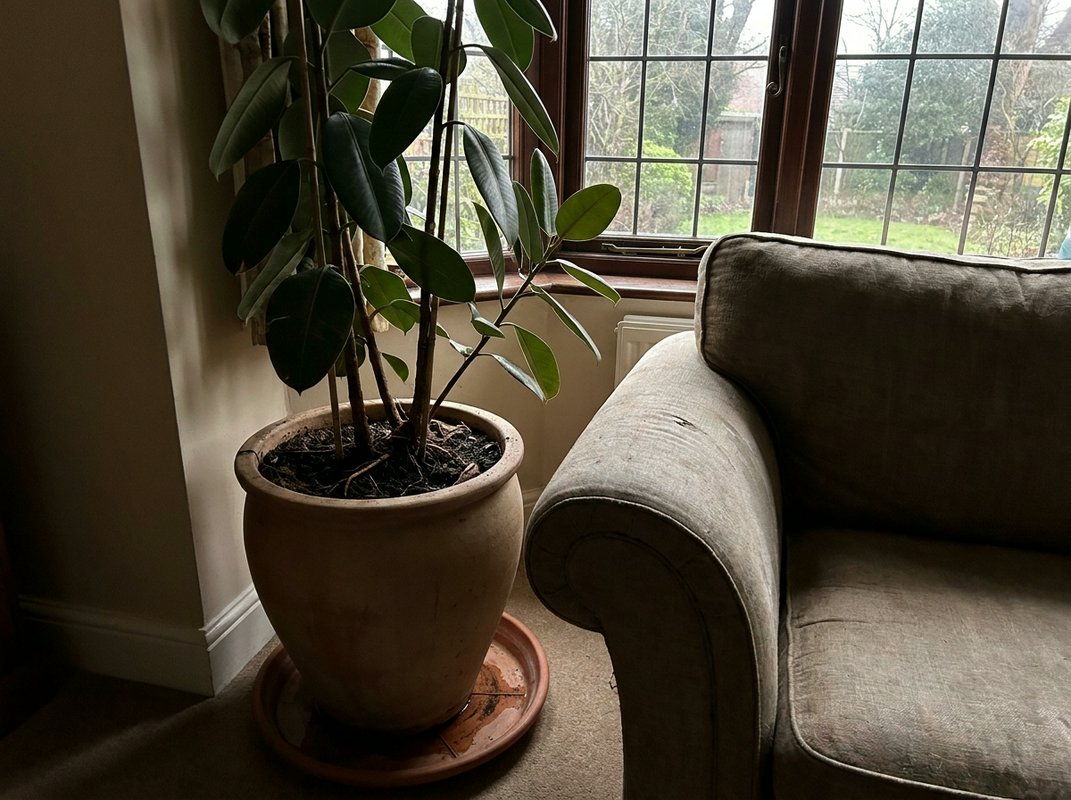
A plant placed where you look anyway does more work than a plant placed where there happened to be a gap. The spot at the end of a hallway, the one you face from the sofa, the patch of worktop you see every time you fill the kettle: these are sight lines, and a plant on one of them registers every single day. A plant tucked behind a doorway or against a wall you only pass side-on might as well not be there.
Corners are the usual mistake. A bare corner looks like it needs filling, so a pot goes in it, but a corner is also where the eye stops travelling. Put the same plant where a sight line crosses it instead, such as the point you see first on walking into a room, and it reads as a deliberate feature.
Checking a spot before you commit a plant to it
Stand in the doorway of the room and in the main seated or working position, and look at where your eye actually lands. If a prospective spot is not in that line, it is a storage spot, and it is worth knowing that before buying a plant sized and priced for a role it will not play.
- Entryways and hallways: seen briefly but repeatedly, which suits one strong plant.
- The view from a sofa or desk: seen for long stretches at a sitting height, so a plant here is looked at more than almost anywhere else in the house.
- Windowsills: good light, but often a transit route for hands, cups and curtains, which argues for a sturdy pot over a delicate one.
- Deep corners and spots behind furniture: low visibility and often low light too, better reserved for a plant that tolerates both than for one you actually want to notice.
None of this changes what a plant needs to stay healthy. A spot with the right sight line but poor light is still a poor light spot, and the light a plant gets matters more than how good it looks there. Where the two pull in different directions, the honest fix is usually a different plant for that position.
Why three pots beat five
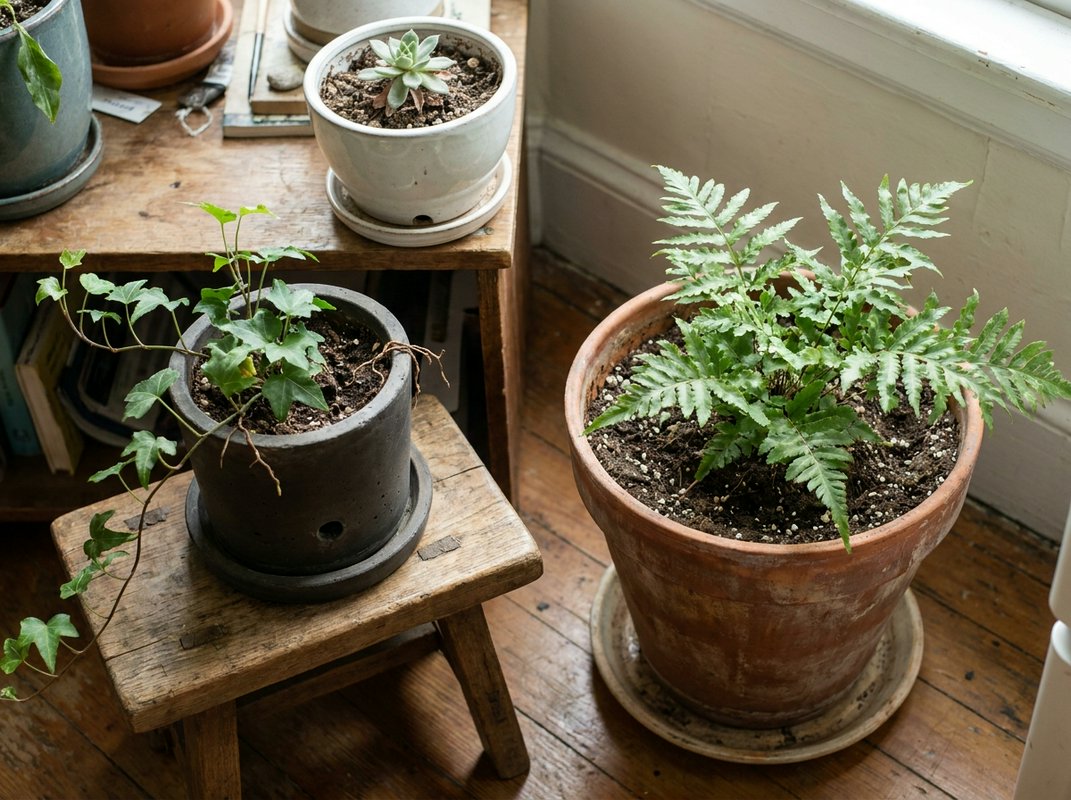
A row of identical pots reads as storage. A group of three in different heights and different materials reads as something someone arranged on purpose.
Why three, not five
An odd number avoids the symmetry that makes a group look like a matched set, which is what you want from cutlery and don't want from plants. Three is usually enough: it gives you a tallest, a shortest and one in between, and the eye can take in all three without working at it. Five or more of the same pot tends to flatten into a block of green, and the room stops noticing it.
Why the heights should differ
Stagger the heights rather than lining up the rims. A tall snake plant, a mid-height pothos trailing from a shelf, and a low, wide pot of succulents on the sill below it gives three different levels for the eye to land on.
Why mixed materials work harder than matched ones
A terracotta pot, a glazed ceramic one and a woven basket catch light differently and sit differently against a wall, so the grouping reads as deliberate. Matching the three pots exactly removes that contrast and the grouping goes back to reading as storage. The plants inside still need the same attention to drainage and watering as they would individually: putting a terracotta pot and a sealed ceramic one side by side doesn't change what either plant needs underneath.
Matching scale to the room
A single floor-standing planter does something a shelf of small pots cannot, and the reverse is just as true. The question is which suits the room the plant is actually standing in.
Why a small room needs fewer, larger things
A small room filled with several small pots reads as clutter, because the eye has nowhere to land. One floor-standing planter, sized to the room, gives the space a single anchor. This is partly a question of the pot itself: a tall container in terracotta, glazed ceramic or fibreglass holds enough soil volume to support a larger plant without needing frequent repotting, which matters in a room where there is nowhere to put a bigger pot every time the old one is outgrown.
Why a large room needs more, smaller things
The same single planter can get lost in a large room, where the walls and furniture are already working at a bigger scale. A shelf or grouping of smaller pots fills that scale with variation. This only holds if the grouping has some structure to it, varied heights and more than one pot.
Matching the container to the room
It helps to start with the room's proportions before choosing a pot size, and only then check that the plant inside it will actually be happy there. A plant that wants a large volume of soil, a fiddle leaf fig or a tall snake plant, can suit a floor-standing planter in a small room precisely because that room cannot take several competing pots. A plant that stays small, a succulent or a trailing pothos, works better as one of several on a shelf in a room with space to spare. Where the two pull in different directions, the room's scale should usually settle it.
Can a decorative pot with no drainage hole work?
A pot with no hole underneath is often the better-looking choice, and in a lot of rooms that is the whole reason it got bought. Before it goes near a plant, though, it is worth knowing what that missing hole actually changes.
What a sealed base does to a plant
Water you pour in has nowhere to go. It sits at the bottom of the pot, and the roots above it sit in that standing water. Roots need air as well as moisture, and a base that stays wet starves them of it, which is how root rot starts in a pot that looked perfectly fine from the outside.
Using a decorative pot without the risk
The fix is to keep the plant in its original container, the one with a drainage hole, and set that inside the decorative pot as a liner. The decorative pot becomes the outer shell; the plant never actually grows in it. After watering, lift the liner out and tip away whatever has collected in the base, or watch the water level if the liner sits loose enough to see into.
- Keep the plant in its original drainage-holed pot and treat the decorative pot as the outer shell only
- Check the base of the decorative pot after each watering and pour off anything that has collected
- Leave enough gap between liner and outer pot that air can move.
When the sealed pot is the wrong choice
Some plants make this harder to get right. A succulent or cactus wants its soil to dry out properly between waterings, and a liner sitting inside a sealed base is working against that from the start, because any water that escapes the drainage holes has nowhere to drain to. A tall floor-standing planter has the same problem at a larger scale: lifting a heavy liner to check for standing water is awkward enough that it tends not to happen, and that is usually when the damage is done. In both cases, a planter with its own drainage hole and a saucer underneath is the simpler choice, even if it was not the one that first caught your eye on the shelf.