
When a pot has nowhere for water to go
Covers the drainage setups indoor growers actually face: holes and saucers, liners for sealed pots, and what to do when a ceramic has none at all.
Read the plant care guides Check a drooping or yellowing plant with the Plant Health CheckerWhat happens to a plant's roots when water can't drain away
Why roots need air as well as water
Roots don't just drink water, they also breathe. The soil around them is threaded with air pockets, and in between waterings the roots draw oxygen out of those gaps. Water fills the same spaces the air was sitting in, and if the pot gives it nowhere to go, it stays there until that oxygen is gone.
What a root does once the oxygen runs out
A root that's lost its oxygen supply stops functioning within days, well before anything shows in the leaves. It can't draw up water or feed the plant the way a healthy root does, which is why a plant sitting in waterlogged compost often looks thirsty even though the soil is soaked. The leaves droop at the same time the compost stays wet. Left for long enough, the root tissue itself starts to break down, and a plant can lose a good part of its root system before a single leaf gives any sign of it.
What to check on your own plant
You don't need to take a plant out of its pot to get a sense of whether this is happening to it.
- Press a finger into the soil a few centimetres down before watering again. Soil that's still wet there for days after the last watering is holding onto water.
- Lift the pot. One that still feels heavy days after watering, when it should have dried out and lightened, is sitting on water it hasn't lost.
- At the next repot, look at the roots themselves. Healthy roots are firm and pale. Roots that have gone soft, dark and give off a sulphurous smell have already started to rot.
Choosing the right pot and drainage setup for a specific plant from the start heads off most of this. The planter finder tool takes the plant, the room it's going in and how often you'd rather water, and works out a material, size range and drainage setup to suit, with the reasoning behind each one.
Why a hole and a saucer can still go wrong
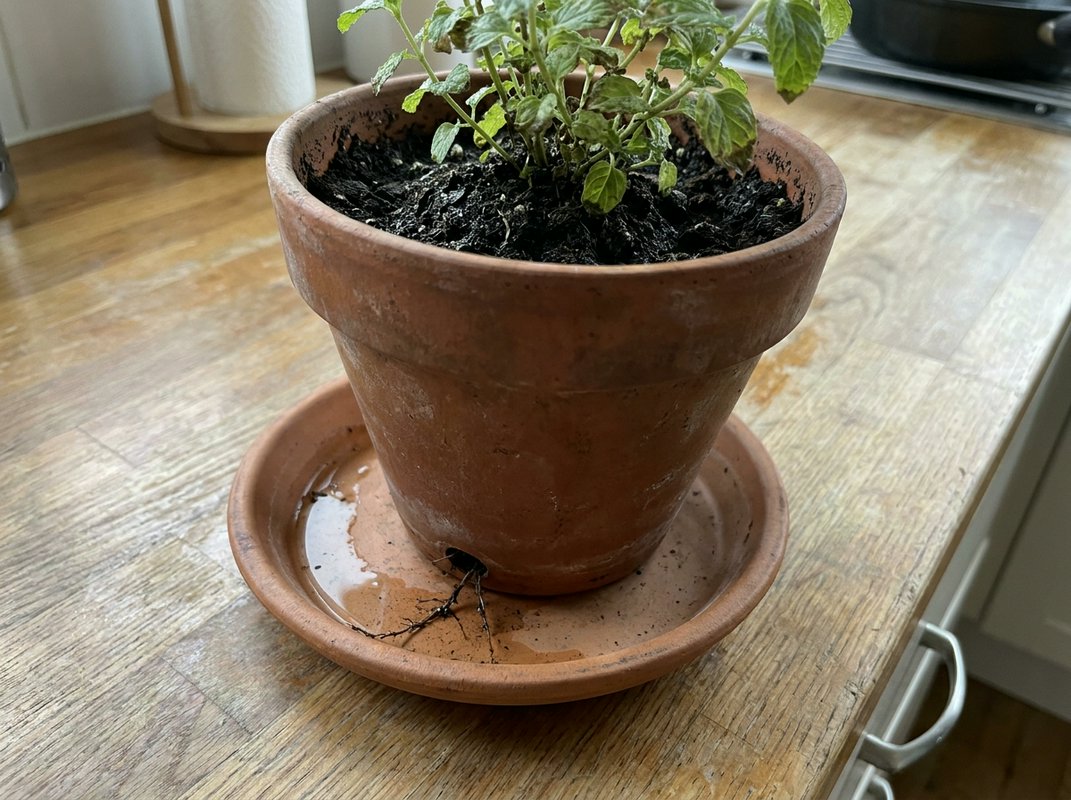
A pot with a hole in the base and a saucer underneath it is the setup most plants are sold in, and it works because it does one simple thing well: water passes through the compost, carries away whatever the roots did not take up, and leaves through the hole rather than pooling around them. The saucer exists to catch that water so it does not run onto the windowsill or the floor. On its own, that is all the mechanism a healthy plant needs.
The setup fails when the saucer is treated as a reservoir rather than a catch tray. Water sitting in the saucer touches the base of the pot, and compost draws it straight back up through the drainage hole by the same capillary action that waterlogs a sealed ceramic pot with a liner inside it. A plant can look perfectly watered and still be standing in water an hour later, with roots re-soaking from below while the surface of the compost looks dry.
The mistakes that undo it
- Leaving the saucer full after watering.
- Using a saucer too shallow for the amount of water a large pot releases, so it overflows onto the surface underneath before anyone has checked it.
- Choosing an unglazed terracotta saucer for a varnished wooden floor or a carpet, since unglazed clay wicks moisture outward as well as down and leaves a ring that outlasts the plant.
- Assuming a deeper saucer is safer, when a deep saucer that is never emptied holds more water against the pot base for longer.
None of this calls for a different pot, only a different habit: water, wait for it to finish draining, then empty what has collected. If you are choosing a pot and saucer for a plant you are about to buy, the planter finder will suggest a drainage setup sized to that plant and the room it is going in.
Fitting a liner pot inside a decorative one
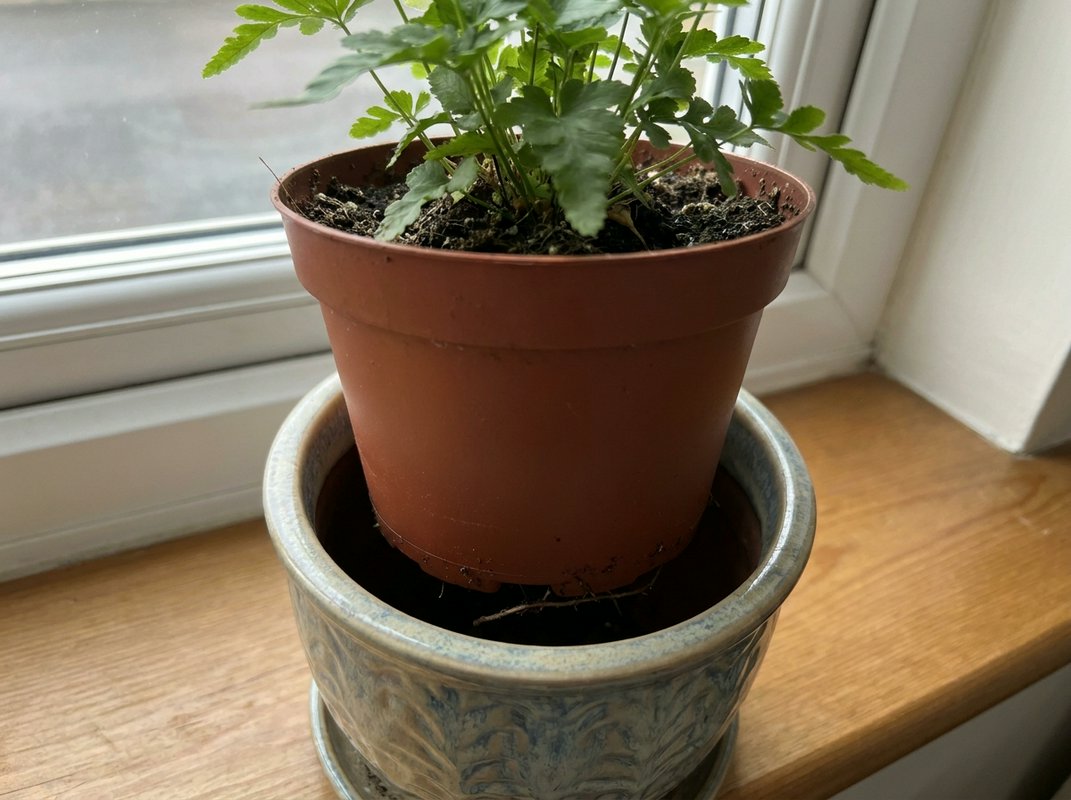
A decorative pot with no drainage hole can still hold a healthy plant, as long as the plant itself is never potted directly into it. The trick is to keep the plant in a separate pot that does have holes, usually its original nursery pot or a plain plastic one the same size, and let the decorative piece act as a cover. Water drains through the inner pot and collects in the gap below it, away from the roots.
Getting the size of that inner pot right matters more than it looks. Too tight a fit and you will find out only when you try to lift it out to water over the sink, because a nursery pot wedged against ceramic can jam. Too loose and it rocks, tips, or lets water run unevenly down one side. A gap of a couple of centimetres all round is enough to let you grip the rim and lift the plant clear, while still sitting steady inside the outer pot. If you are starting from scratch, the planter finder takes the plant and the room into account and suggests a size range and drainage setup to match.
When to empty the outer pot
Water left in the base of a sealed decorative pot does not disappear. It sits there, and if the inner pot's drainage holes are low enough to touch it, the compost will draw it straight back up by capillary action, which puts the roots back in standing water within a day or two. Check the base around fifteen to twenty minutes after watering, tip the plant slightly to see how much has collected, and pour it away if there is more than a shallow film. On plants in low light or cooler rooms, where the compost dries slowly, leaving that water in place is the single most common reason a plant that looked fine in the shop starts to decline a few weeks after it moves in.
Can you add drainage to a pot that doesn't have it?
A sealed ceramic pot with no drainage hole can be made to work, but drilling one is not always the right move, and it is worth knowing when to leave the pot alone before you reach for a drill.
When drilling makes sense
Glazed stoneware and most fired ceramic will take a hole if you use the right bit. A tile or masonry bit, run slowly with the pot supported and kept wet to stop the glaze cracking, will usually get through without splitting the base. This is worth doing on a pot you intend to use as the main container for years, especially for a plant that needs its roots to dry out between waterings. It is not worth doing on a pot you are unsure about, or one with a thin or already-stressed base, because a crack at this stage means the pot is finished.
Why the gravel layer keeps coming back
Putting a layer of gravel or crocks in the bottom of a pot with no hole is common advice, and it looks sensible: a reservoir below the roots, out of the way. It does not work that way. Water does not move from fine compost into coarse gravel until the compost above the gravel is already saturated. The roots sit in sodden soil for exactly as long as they would without the gravel, and the gravel layer also eats into the usable depth of the pot, so the plant ends up with less room for its roots as well. A gravel layer does nothing to replace a missing drainage hole.
When to leave the pot alone
Some pots are better used as the outer, decorative layer with a separate liner pot inside that does the draining. This is the right call for anything thin-walled, hand-finished, or valuable enough that a cracked base would be a real loss, and for anything you are not confident holding steady under a drill. It is also the simpler option generally: a liner pot can be lifted out to water and drained in a sink, which a drilled pot sitting on a shelf cannot offer you. If you are choosing between drilling a pot you already own and buying one suited to the plant from the start, the Planter Finder tool will suggest a material and drainage setup based on the plant and the room, which is often the quicker answer.
Checking a drilled pot is doing its job
- Water until it runs from the new hole.
- Check the hole has not become blocked with compost or a stray root.
- Stand the pot on a saucer or riser.
- Watch the first few waterings closely, since a hole drilled off-centre can sit higher than the compost level and drain less than it looks like it should.
How do you stop a saucer overflowing onto the floor?
Why a saucer overflows in the first place
Water poured onto soil runs straight through the drainage hole until the compost has taken what it can hold, and the rest collects in the saucer underneath. A saucer only holds so much before it reaches its rim, and once it does, the next splash of water goes over the side. This is most likely with a generous pour, a saucer sized to match the pot, or a saucer left unemptied from the last time round.
Self-watering trays overflow for a different reason
A self-watering planter holds its water in a reservoir below the pot, drawn up to the roots through a wick system (a cord or strip of absorbent material that carries water upward by capillary action). Topped up without checking the level first, that reservoir fills past its own capacity in just the way a saucer does, and the water that cannot go anywhere else comes out at the base of the tray. A reservoir with no visible window to check the level is the one most likely to catch you out, because there is nothing to look at before you pour.
What standing water does to a wooden floor
Wood reacts to water sitting against it for any length of time, whether that's a solid floor, an engineered one or a laminate finish. The surface can cloud, the lacquer can lift at the edges, and repeated soakings can cup or warp the boards at the join. None of this needs a flood. A saucer left full against bare wood overnight is enough to start it.
What standing water does to a rented carpet
Carpet pulls water sideways through the pile, so a small overflow spreads further. Left to dry on its own, that patch dries more slowly than the carpet around it, and a slow-drying patch is where mould takes hold. On a rented carpet, that isn't just a damp patch. It's the kind of mark a deposit inspection is built to notice.
Cutting the risk
- Choose a saucer with a visible margin above the pot's own base.
- Stand the pot on feet or a small riser so the saucer underneath has room to hold water without the base of the pot sitting in it.
- Put something water-resistant under the saucer itself, such as a cork mat or a sealed tray.
- Empty the saucer once the compost has stopped drawing from it.
- Check a self-watering reservoir's level before topping it up.
If you're still choosing the pot itself, the planter finder tool asks about the room, the plant and how often you'd rather water, and suggests a drainage setup sized to match, which is the easiest way to avoid a saucer that's wrong for the job from the start.
Still not sure what's wrong with the plant?
Yellowing leaves, a sour smell from the pot, or soil that stays wet for days are usually signs of a drainage problem.