
Pothos care: light, watering and the right pot for trailing
Pothos puts up with a missed watering and a dim corner better than most houseplants, but it still grows best with the right light, the right pot and somewhere for the stems to fall. This guide covers what a pothos in a UK home actually needs.
See more plant care guidesHow much light does a pothos actually need?
Pothos is often sold as a plant that does well almost anywhere, and for the most part that holds. Give it bright indirect light, meaning a spot near a window but out of the sun's direct path, and it will grow steadily with new leaves pushing out every few weeks through spring and summer. That is the light it does best in.
What a north-facing shelf actually gives it
A north-facing window in a UK home never gets direct sun, so the light reaching a shelf there is lower and flatter than anywhere else in the room. Pothos handles this better than most trailing plants, which is why it turns up so often in exactly this spot. Growth slows, especially from autumn through to late winter when UK day length is already short, and the gaps between leaves tend to lengthen as the plant stretches towards whatever light there is.
What changes with variegation
Varieties with white or yellow marbling on the leaf, such as marble queen or pearls and jade, rely on reaching a reasonable level of light to keep that pattern. In low light they often revert, producing new leaves that are plain green because the plant is putting its energy into chlorophyll. A solid-green pothos such as jade or neon does not have this problem, since there is no variegation to lose.
Reading the plant on a low-light shelf
On a north-facing shelf, expect slower growth and a plainer leaf colour on variegated types. If new leaves come out noticeably smaller than the ones already on the plant, or growth stalls completely over several months, that is the point to move it a little closer to the window rather than assume something else is wrong.
How often to water a pothos
A pothos copes far better with a missed watering than a wet one. The plant stores water in its leaves and stems, so going a little too long between drinks sets it back less than roots sitting in damp soil for weeks on end. The rule to work from is the top 2 to 3 cm of soil: once that has dried out, it is time to water again, and until then it is not.
Checking the soil rather than the calendar
Push a finger into the soil near the edge of the pot, down to about the second knuckle. If it feels dry at that depth, water thoroughly until it runs from the base of the pot. If the soil is still cool or slightly damp, leave it and check again in a few days. A pot that still feels heavy for its size is usually still holding water lower down, even if the surface looks dry.
Why the gap between waterings changes through the year
In a British winter, with shorter days and often lower light reaching the plant, that top layer typically takes around 10 to 14 days to dry out. The exact figure depends on two things working together: the pot itself and the room it sits in. Terracotta draws moisture out through its walls as it dries, so a pothos in a terracotta pot generally needs watering sooner than one in glazed ceramic or plastic, where the material holds moisture against the soil for longer. A warm, centrally heated room dries the soil faster than a cooler one, even with an identical pot, so the same plant on a radiator shelf and one on a cool windowsill can be on noticeably different schedules.
Whatever the pot is made of, it only works in the plant's favour if excess water actually has somewhere to go. If you're weighing up pot types or sorting out what to do with a decorative pot that has no drainage hole, the planter material guide and the drainage guide cover that in more detail.
Give the stems somewhere to fall before you give the roots a bigger pot
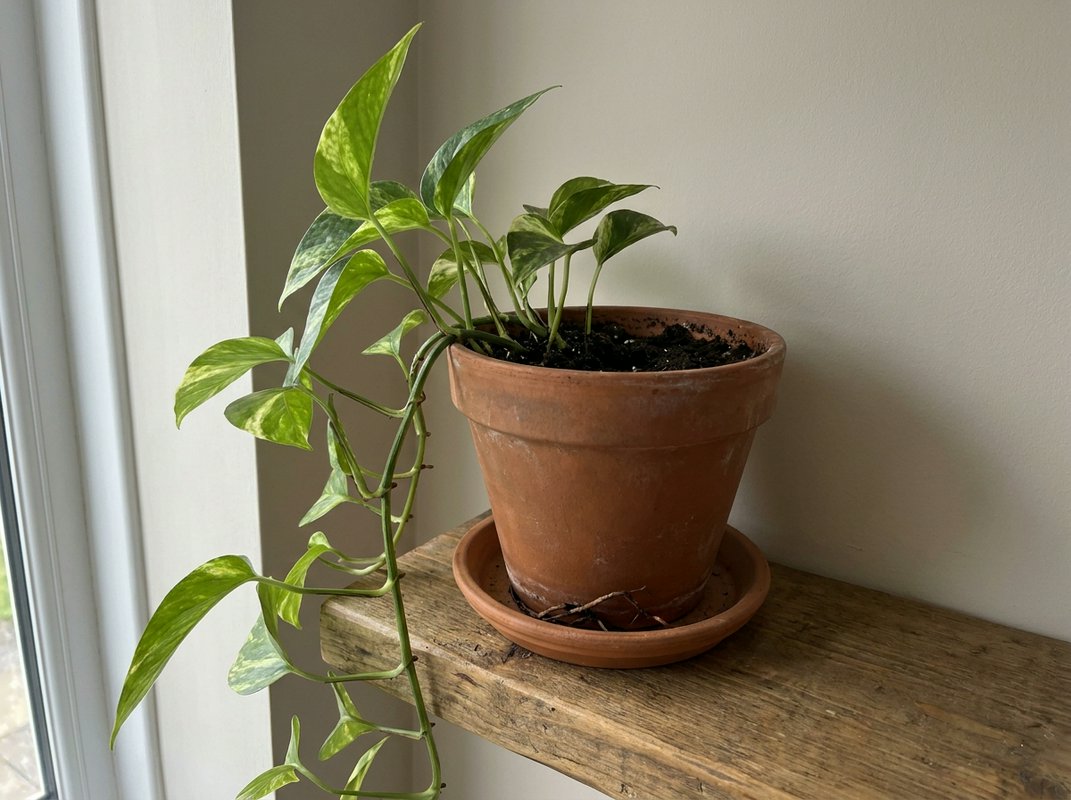
A hanging pot or a shelf set above head height lets trailing stems fall freely. Pothos grows this way naturally, trailing or climbing from a fixed point, so a position with open space beneath it keeps the stems growing in one direction.
The pot itself can stay smaller than the spread of foliage suggests. Pothos puts on stem and leaf growth faster than it fills a pot with roots, so the usual rule for sizing up applies here too: move no more than 2-3cm in diameter at a time (see how to choose the right planter size). A modest pot with a drainage hole and a saucer set underneath, whether on a shelf or hung (see drainage for indoor planters), will support stems trailing well beyond what the pot's own size implies.
Divide rather than pot up
Where a pothos actually needs attention is often at the base. A pot grown on from several cuttings, or left to fill out over a few years, often turns out to hold a few distinct rooted clumps sharing one pot. If you tip the plant out at repotting time and find sections that pull apart with their own roots attached, dividing them into separate pots usually suits the plant better than forcing all of it into one larger container. Each clump gets a pot sized to its own roots, and the stems have room to trail without crowding each other at the rim.
Why your pothos is leggy, yellowing, or losing its pattern
A pothos that's struggling almost never needs more fuss. It usually needs a different spot or a different pot. The same three problems come up again and again: long bare stems, yellow leaves, and new leaves that come in plain green.
Leggy growth with big gaps between leaves
A stretched-out stem with long gaps and no new growth near the base means the plant is reaching for light it isn't getting. Pothos copes with low light, but it stops filling out there. Move it to within a metre or so of a window with bright, indirect light and the gaps on new growth should close up.
Check the pot before you blame the light alone. A plant that's been in the same pot and the same soil for a couple of years, with no feeding, often puts its energy into stretching, and a root-bound plant (one whose roots have filled the pot and circled round with no room left to grow) behaves the same way. If you're not sure how to tell, the guide on choosing the right planter size covers what to check and when it's worth moving up a size.
Once the light is sorted, cut leggy stems back to just above a leaf node. This forces the plant to branch. The cuttings will root in water within a few weeks if you want to plant them back into the same pot to thicken it up.
Yellowing leaves, usually from the bottom up
Lower leaves turning yellow and dropping is nearly always a watering issue. Push a finger into the soil to 2 to 3 cm. If it's still damp, hold off watering.
Check the pot itself next. A pot with no drainage hole, or a saucer that's been left to collect water after the last watering, keeps the roots sitting wet long after the surface looks dry. The drainage guide covers how to fix this without replacing the pot, including using a liner inside a sealed decorative pot. One or two yellow leaves low down on an otherwise healthy plant is often just old growth being shed.
Loss of variegation in new leaves
When new leaves come in solid green instead of the white or yellow marbling the plant had before, that's a light problem specifically, not a watering one. The pale sections of a variegated leaf have no chlorophyll, so in low light the plant starts producing plain green growth because that's the only tissue still generating energy for it.
Moving the plant to brighter indirect light will bring the pattern back on new leaves, though leaves that have already come in green will stay green. Pruning those plain stems back encourages the plant to put its growth into variegated stems instead.