
Peace lily care: watering, humidity and the right pot in a British home
A drooping peace lily is telling you something specific. This guide covers what the leaves mean, how often to water through a UK winter, and which pot makes that easier.
See the full range of plant care guidesLight and placement for a peace lily
A peace lily grows naturally under tree cover, in the dappled shade of a forest floor. That background is why it tolerates rooms that stop most other flowering houseplants in their tracks: it's built for filtered light.
Why direct sun causes damage
Put a peace lily in direct sun and the leaves pay for it. A few hours of strong afternoon sun through a south or west-facing window is enough to bleach patches pale yellow or scorch the edges brown and crisp. The damage doesn't reverse once it's there, so the leaf stays marked until it's eventually replaced by new growth.
Why a north-facing room works
Most houseplants that flower need reasonably bright light to do it. A peace lily is one of the few exceptions, which is what makes it useful in a north-facing room where options are otherwise thin. Stand it a metre or so back from the window, or to one side of it. The light there is indirect for most of the day, which is exactly what it wants.
Reading the plant's own signal
- Pale, washed-out leaves point to too much direct sun.
- Stems stretching towards the window, with fewer flower spikes point the other way, to a spot that's too dark for it to flower reliably.
Moving the pot a little further from or closer to the glass is usually enough to correct either.
When to water a peace lily, and why winter air works against it
A peace lily tells you what it wants through its soil. Push a finger into the compost: if the top 2–3 cm feels dry, it's time to water. If it's still damp at that depth, leave it and check again in a few days. Watering on a fixed schedule, every Sunday regardless of how the soil feels, is how peace lilies end up either parched or waterlogged, because how fast that top layer dries depends on the room, the season and the pot it's sitting in.
Why a schedule falls apart in winter
Light levels drop and growth slows right down over a British winter, so a peace lily uses less water and the soil stays damp for longer between waterings. The same routine that worked in July, watering twice a week, can mean a plant sitting in wet compost in January. Checking the top few centimetres each time is the only way to catch that change as it happens. When you do water, water thoroughly until it runs through the drainage hole and out, then let the pot finish draining before it goes back on its saucer or into its cover pot. Details on managing that runoff, including what to do with a decorative pot that has no hole at all, are covered on the drainage guide.
Why central heating is the bigger problem
A peace lily comes from the understorey of a tropical rainforest, where the air is warm and heavy with moisture all year round. Central heating creates almost the opposite condition. It warms the air in a room, and warmer air can hold more moisture than cool air, but running the heating does not add any moisture to it. The result is air that feels comfortable to a person and is drier, in relative terms, than the air the plant actually evolved for. That mismatch doesn't show up as drooping, which is a soil problem. It shows up as crisping along the leaf tips, which is an air problem, and it tends to appear through the winter months precisely when the heating is on most.
Standing the pot on a tray of damp gravel raises the humidity in the immediate area around the leaves without waterlogging the roots. Grouping it with other houseplants has the same effect, because each plant releases moisture as it transpires. Neither fixes dry soil, and neither is a substitute for checking that top 2–3 cm before you reach for the watering can.
Does the pot change how often a peace lily needs water?
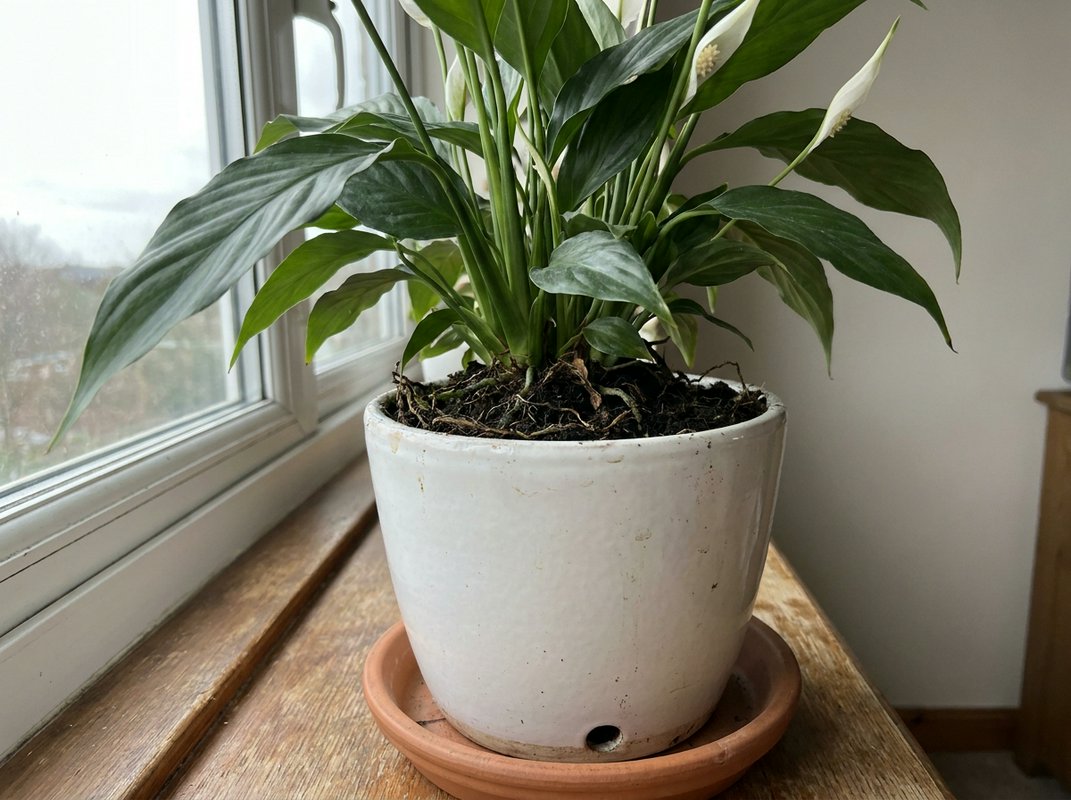
A peace lily dries out at different speeds depending on what it's sitting in, and that speed decides how much attention it needs from you. Glazed ceramic and plastic both hold moisture in the soil for longer, because the material itself doesn't let water pass through the walls of the pot. Terracotta is porous, so it draws moisture out through its sides as well as from the surface of the soil, and a peace lily in an unglazed terracotta pot will need watering noticeably more often than the same plant in glazed ceramic or plastic.
Neither is the wrong choice. If you tend to forget plants for a week or two, glazed ceramic or plastic gives you more room before the soil runs dry. If you like a terracotta pot and don't mind checking the soil every few days, that faster drying can actually help, since a peace lily is one of the easier houseplants to overwater in anything that holds moisture well. The pot doesn't change how often a peace lily droops when it's thirsty, but it does change how often you'll be reaching for the watering can to stop that happening.
Whichever material you choose, the pot needs a drainage hole. A peace lily sitting in trapped water at the base of the pot is far more likely to develop root problems than one that dries a little faster between waterings.
Brown tips, yellow leaves and when a self-watering pot helps
A peace lily that has lost its shine usually shows one of two complaints: crisp brown tips on otherwise healthy leaves, or whole leaves turning yellow and soft. They can look similar from across the room, but they come from opposite causes, and treating one like the other tends to make things worse.
Brown, crispy tips
Brown tips show up when the air around the plant is drier than the leaf can cope with, which in a British home usually means a radiator or a gas fire running through the winter months. The tip is furthest from the root, so it is the first part of the leaf to suffer when the plant cannot pull up moisture fast enough to replace what it is losing. Moving the pot away from direct heat and standing it on a tray of damp gravel, with the base of the pot kept clear of the water itself, raises the humidity around the leaves without wetting the roots.
Yellow, soft leaves
Yellowing points to a different problem, and a more serious one. It usually means the roots have been sitting in wet soil for longer than they can use it and have started to rot. It tends to start with the lower, older leaves, and the soil will feel wet well below the surface. Checking the drainage the pot actually offers is worth doing before assuming the plant simply needs more watering, since a blocked or missing drainage hole leaves excess water with nowhere to go.
Where a self-watering pot earns its place
A self-watering planter works through a reservoir and a wick, a cord or column of absorbent material that draws water up from a tank below the soil as the plant uses it. A peace lily that droops hard when it dries out and resents being left wet suits that steady supply far better than a succulent or a cactus does, since those plants need the soil to dry out fully between waterings and will rot in the same setup. It is one of the few houseplants where the mechanism works with the plant's habits.