
Orchid care in the UK: watering, pot type, light and reblooming
An orchid asks for something different from every other plant on your windowsill, starting with the pot it sits in. This guide works through watering, container choice, light and what brings it back into flower, for a British home.
Read more plant care guidesWhy orchid pots are see-through
Most houseplants grow roots that sit in the dark, doing their job out of sight. A phalaenopsis orchid does not work that way. Its roots carry chlorophyll, the same pigment that colours leaves, and they photosynthesise alongside the leaves. That is also why orchids are usually sold and grown in a thin plastic pot with slots down the sides: the roots need light reaching them.
The clear pot is not styling. It is how you read the plant. A healthy, hydrated orchid root looks green, because that is the chlorophyll showing through. As the root dries out, it turns a pale, silvery grey. You do not need to lift the plant, prod the medium or guess from the surface, because the colour of the roots through the side of the pot tells you directly whether there is still moisture down at root level.
Reading the colour correctly
Check the pot in reasonable daylight. Grey roots mean it is time to water. Green roots mean leave it, even if the bark on top looks dry, since bark dries out faster than the roots sitting underneath it. A root that has gone soft, brown or papery is a different problem, usually rot rather than dryness, and colour alone will not tell you which.
How often should you water an orchid?
Most orchids sold as houseplants are phalaenopsis orchids, and in the wild they grow as epiphytes. That means the roots cling to the bark of a tree, drying out completely between rainfalls before taking up a large amount of water in one go and then sitting in humid air until the next downpour. A pot that stays damp all the time asks the roots to do something they were never built for, and rot follows.
Soak and drain, not a daily splash
Watering an orchid well means a thorough soak followed by a complete dry-out. In a British winter, with the heating on and light levels low, that cycle works out at roughly every 7 to 10 days. Once summer brings longer days and faster growth, the same plant gets through its water sooner and wants soaking about once a week. Run water through the pot until it runs freely from the base, then let it drain fully before the pot goes back into its saucer or cachepot.
Why the ice-cube method falls short
The ice-cube method, placing a cube or two of ice on the bark each week, was devised as a simple way to sell orchids to people worried about getting watering wrong. An orchid in its native range is never watered with anything close to freezing, and a slow trickle of meltwater is a poor stand-in for the deep soak and full dry-out the roots rely on. A cube or two will not rot the plant on its own, but it will not deliver the soak-and-drain rhythm that keeps the roots healthy through a British winter either.
Setting up the pot: an inner pot inside an outer one
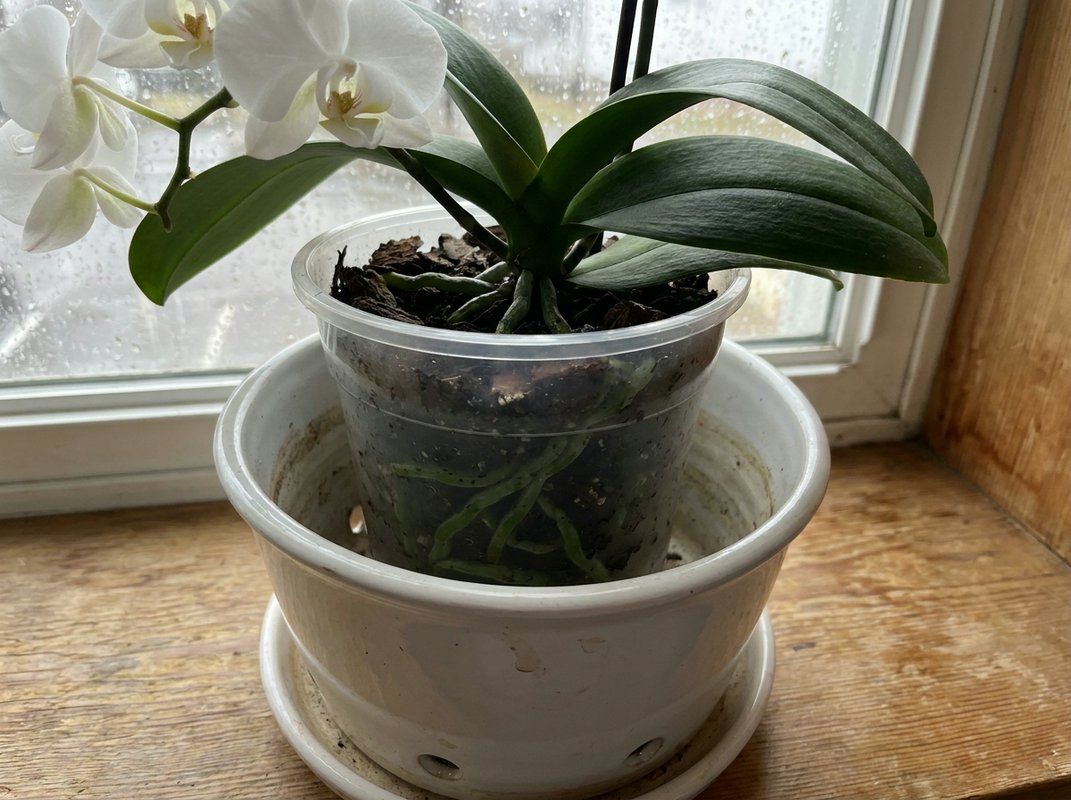
An orchid usually arrives sitting in a plain plastic pot, pushed inside a decorative outer pot (a cachepot) that has no hole at all. That inner pot is doing the actual work. It needs slots or holes around the base so water can run straight through the bark, because orchid roots need air moving round them.
The outer pot is there to look good and to catch what drains out, nothing more. Size it two to three centimetres wider than the inner pot all round, enough for the inner pot to lift out cleanly for watering and to sit back in without wedging. An outer pot that grips the inner one too tightly traps water in the gap between the two, and a trapped puddle sitting against the base of the plastic pot defeats the point of the slots.
Why bark needs a different shape of pot from moss
Bark chips are chunky and leave large air gaps between them, so water passes through fast and a shallow, wide pot lets it drain and dry evenly. Moss holds water much longer and packs tighter, so a pot growing orchids in moss is usually narrower and a bit deeper, giving the moss room to dry out from the sides. Repotting from one medium to the other without changing the pot shape is a common reason an orchid that was previously fine starts sitting in damp conditions it cannot cope with.
If you are weighing up pot materials more generally, including why some retain moisture far longer than others, the plant care guides cover that ground for a range of houseplants, and the drainage mechanics behind slots, saucers and liners are set out in full on the drainage guide.
What makes an orchid flower again
A phalaenopsis that has finished flowering is not finished. It drops its last bloom and sits there, leafy and apparently idle, and most owners read that as the end of the story. It isn't. The plant is waiting for a signal that tells it autumn has arrived, and without that signal it can sit leafy for a long stretch without starting a new spike.
The signal is a temperature drop
In its native range, a phalaenopsis flowers after nights turn noticeably cooler than the days around them, the shift that marks the end of a tropical wet season. The plant has no calendar. It reads the gap between day and night temperature, and once that gap opens up for a sustained stretch, it starts building a new flower spike.
This is where a British windowsill does something useful almost by accident. A room that holds a fairly even temperature through the day but cools properly after dark, because the heating has gone off and the glass beside it loses warmth fast, is producing exactly the pattern the plant is looking for. You don't need to engineer this. An orchid kept on a windowsill through a normal autumn is already getting the cue, provided it isn't on a sill above a radiator that keeps the air artificially warm all night.
What to watch for once the nights turn
The response isn't instant. Over the following weeks, look at the base of the leaves for a small green point pushing out from between two leaves. That's a new spike starting, and it's easy to mistake for a root tip at first glance: a root tip is rounder and usually silvery-green, a spike nub is flatter and stays green as it lengthens.
- A flattened green point at a leaf base is the first sign a new spike is forming
- It can take several weeks from the first cold nights for that point to appear
- A sill kept warm all night by a radiator underneath won't produce the same drop, even if the room looks cool
If nothing appears once winter has properly set in, the pot setup and watering routine are worth checking before anything else, since a plant that isn't getting the moisture or root conditions it needs won't put energy into a new spike regardless of temperature.