
Monstera care for a British flat
Light, watering depth, pot size and the problems that actually turn up in UK homes, covering what a monstera needs through a British winter and a British summer.
Read more UK plant care guidesHow much light does a monstera need?
Light does more to shape how a monstera grows than any other single factor, watering included. Get it right and the plant pushes out larger leaves with deeper splits; get it wrong and it keeps growing, just slower, smaller and plainer, which is often mistaken for a watering problem when it isn't one.
What changes between a British summer and a British winter
A monstera wants bright, indirect light, and how much of it actually reaches the plant shifts a great deal across a UK year. In summer, a spot a few steps back from an uncovered south or west-facing window usually supplies enough without any risk of the leaves scorching. By December the sun sits lower and the days are short, and that same spot can leave the plant under-lit for months. Moving the pot nearer the glass, or into the brightest window in the room, over the darker months is ordinary seasonal care.
What north-facing means for it
North-facing windows never get direct sun, so the light coming through one is weaker and flatter than through any other aspect, and that gap widens in winter when there's less daylight to begin with. A monstera will live in a north-facing room, but it grows more slowly, its leaves come out smaller, and it's far less likely to split (fenestrate) than one kept somewhere brighter. Where a north-facing window is all there is, giving the plant the clearest, least obstructed part of it counts for a good deal more than it would in a room with light to spare. A different houseplant might cope with that same spot without complaint, which is worth knowing before assuming the room itself is the problem.
What leggy growth is telling you
Leggy growth, long bare stretches of stem between leaves, with the whole plant leaning or craning toward the window, is the clearest sign a monstera isn't getting enough light. It's the plant stretching to find more of it, and leaves produced during that stretch tend to come out smaller and less split than the ones made before. Turning the pot or moving it nearer a bright window usually slows the stretching within a few weeks. Cutting back the leggy growth afterwards encourages the plant to branch.
How far should the soil dry before you water?
A monstera's watering needs follow the soil. The simplest check is to push a finger, or a thin wooden skewer, into the compost and feel how far down it comes away dry.
The depth to check in winter
Through a British winter, a monstera growing indoors slows down. Light levels drop, the plant puts out little or no new growth, and the roots take up far less water than they did in summer. Let the top 3 to 4 centimetres of soil dry out before watering again. If the skewer comes out with damp compost clinging to it at that depth, leave the pot alone and check again in a few days.
Watering on a fixed schedule through winter is the surest way to end up with wet soil sitting around roots that have nothing to do with it, and that is the usual start of root rot.
Why the figure changes in summer
The same 3 to 4 centimetre check still applies once the weather turns, but the soil reaches it much faster. Longer daylight and warmer rooms push the plant into active growth, and a monstera in full leaf through summer draws moisture out of the pot at a noticeably quicker rate than the same plant in January. Checking once a week is rarely often enough through summer; something closer to twice a week suits a plant that is actively growing.
When the pot goes outside
A monstera brought onto a balcony or patio for the summer dries out faster again, because sun and moving air draw water from the soil surface in a way a still indoor room never does. The 3 to 4 centimetre depth is still the figure to check for. A saucer underneath stops excess water running onto decking or paving. The plant needs to come back indoors before autumn evenings turn cold, because none of these figures hold once temperatures fall below what a tropical plant is suited to.
What pot a monstera actually needs
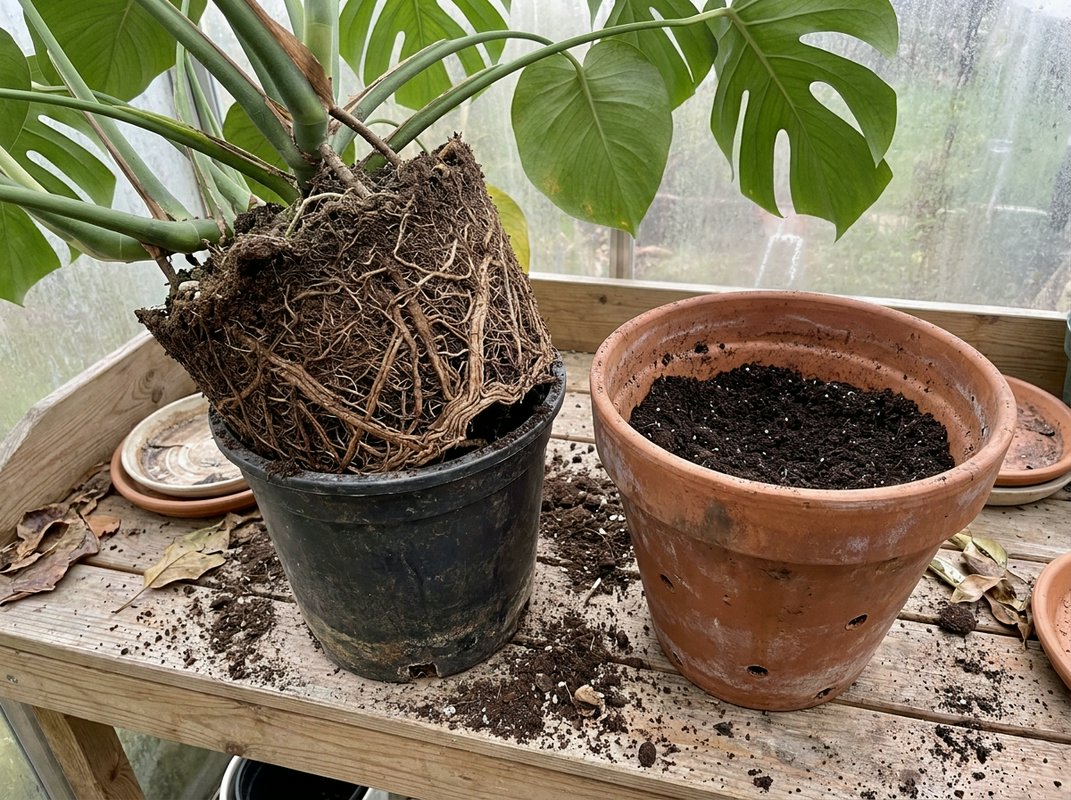
A monstera's roots want room to spread but not room to sit in standing water, and the pot you put it in decides which of those it gets. Terracotta's unglazed clay lets moisture escape through the walls of the pot as well as through the drainage hole, so the soil dries out evenly. A glazed ceramic or plastic pot holds moisture for longer, which only helps if you tend to forget to water and the pot still has a hole for the excess to leave through.
Size the new pot against the root ball. A root ball that already fills its pot, with roots showing at the drainage hole or circling the inside wall (what's usually called root-bound), is ready to move up. The standard move is one size up, which in practice means a pot 2 to 3 cm wider across. A much bigger pot holds far more soil than the roots can take up, and that extra soil stays damp for days longer than the plant can use, which is where rot usually starts.
Repot an established monstera roughly every two years, or sooner if the roots are visibly crowded or water is running straight through the pot without being held at all. Spring is the better time, since the plant is putting out new growth and can recover from the disturbance.
The sealed pot problem
The commonest cause of root rot in a monstera isn't overwatering on its own. It's a decorative pot with no drainage hole, used without a liner pot inside it, so every watering adds to water that has nowhere to go. The plant looks settled in a proper pot, but it's standing in a reservoir at the base that never empties, and the roots sit in that water until they rot.
If the pot you want to use is sealed, keep the monstera in its original plastic or terracotta liner and stand that inside the decorative pot, lifting it out to water over a sink and letting it drain before setting it back in. The drainage guide covers sealed ceramics, liner pots and deep saucers in more detail.
Common monstera problems and what they're telling you
Four symptoms account for most of the questions a monstera owner ends up asking: yellowing leaves, brown tips, leaves that stay whole instead of splitting, and roots appearing along the stem. Each one points somewhere different, and the first job is working out which cause you're actually looking at before reaching for a fix.
Yellowing leaves
A yellow leaf on a monstera almost always comes down to water sitting around the roots longer than they can use it. If it's a lower, older leaf turning yellow and the soil feels wet a few centimetres down, that's the usual pattern, and it's worth lifting the plant out of its pot to check whether the roots are pale and firm or dark and soft. Soft, dark roots mean rot has already started and the plant needs drier soil and a pot that actually lets water leave it. A sealed decorative pot with no liner is a common culprit here, and it's worth reading how a liner setup avoids that before repotting.
Brown, crisping tips
Brown tips point away from the pot and toward the air around the plant. Monsteras come from humid forest conditions, and a centrally heated British flat in winter can run drier than they'd like, which shows up first as crisp, brown edges on otherwise healthy leaves. Tap water with a high mineral content, or a build-up of fertiliser salts in the soil, produces the same kind of browning, usually starting right at the tip. Check whether the browning is confined to leaf edges on an otherwise green, firm leaf: if so, the soil and roots are probably fine, and the air and feeding routine are the places to look.
No fenestration, or leaves that won't split
A monstera that keeps producing solid, unsplit leaves is usually either too young or not getting enough light to bother splitting new growth. The split leaves people buy a monstera for are a feature of mature growth under reasonably bright conditions; a young plant, or one tucked into a dim corner, will often keep producing smaller, whole leaves indefinitely. Check the plant's size and how long it's been growing before assuming something is wrong, and check how much usable daylight the spot actually gets through a British winter.
Aerial roots along the stem
Aerial roots growing from the stem nodes are not a symptom of a problem. In the wild, a monstera uses them to climb and to pull in extra moisture from the air, and an indoor plant will produce them whether it's thriving or just getting by. They can be left alone, tucked into the soil, or guided onto a moss pole if the plant is being trained upright; there's no figure to hit and no need to trim them off unless they're in the way.
Where a symptom doesn't match any of these patterns, or several are appearing together, it's worth stepping back and checking light, watering and pot drainage as a set. The wider range of houseplant problems and their causes is covered across the other care guides.
Work out the right pot before you repot
A monstera's size and condition decide its next pot.