
Fiddle leaf fig care for a British home
A full guide to light, watering and pot choice for fiddle leaf figs grown indoors in the UK.
Read more plant care guidesHow much light does a fiddle leaf fig actually need?
A fiddle leaf fig comes from forest clearings in West Africa, and indoors it carries that habit with it: it wants the brightest light a room can give without direct sun scorching the leaves. Of everything that goes wrong with this plant, more of it traces back to the window it's standing in than to the watering can.
Finding the right window
A south- or west-facing window gives it the strongest, steadiest light a UK home can offer. Stand it close to the glass, but keep it out of a direct beam of summer midday sun, which can mark or scorch the broad leaves within a day or two. A sheer curtain, or a position just back from the pane, takes the edge off that intensity without cutting the light down to something the plant can't use.
What a British winter does to that light
Daylight hours drop a long way between autumn and spring, and a window that felt generous in July can leave the plant short of light by December. Growth slows or stops, new leaves open smaller than the ones before them, and the whole plant leans hard towards whatever brightness it can find. Shifting it closer to the glass for the darker months, or into the spot that would have been too strong for it in summer, is usually enough to carry it through.
Signs it isn't getting enough
- Long gaps between leaves and a stretched, leggy shape
- New leaves noticeably smaller than the older growth
- A pronounced lean towards the window
- Little or no new growth through the winter months
None of these point to anything except more light, which is also why the window matters more than most other decisions you'll make about this plant. If you're weighing it up against other houseplants for the same spot, the care guides for other common UK houseplants cover how their light needs compare.
How often should you water a fiddle leaf fig?
A fiddle leaf fig tells you when it's ready for water, provided you check the right spot. Push a finger into the soil near the trunk: once the top 3-5 cm is dry, water it again, and not before.
Why the top few centimetres
The surface of the soil dries out long before the roots lower in the pot run short of moisture, so judging by what you see on top leads to watering too often. Testing down to 3-5 cm gives a truer sense of what the roots are actually sitting in.
How to water it properly
Water thoroughly rather than little and often. Pour until water runs freely out of the drainage holes in the base of the pot, then let it drain fully before the pot goes back on a saucer or into a decorative cover pot. Standing water left under the roots after a soak does more damage than the soak itself.
Consistency matters more than the schedule
Brown spots on a fiddle leaf fig trace more often to erratic watering than to getting the frequency wrong outright. A week of neglect followed by a heavy soak stresses the plant more than steady under-watering ever does, because the roots are asked to cope with drought and flood in quick succession. In a British winter the soil holds moisture for noticeably longer than it does in summer, so the 3-5 cm check will often stretch the gap between waterings out by a week or more without any change to how you're caring for the plant.
Why the pot needs a drainage hole, every time
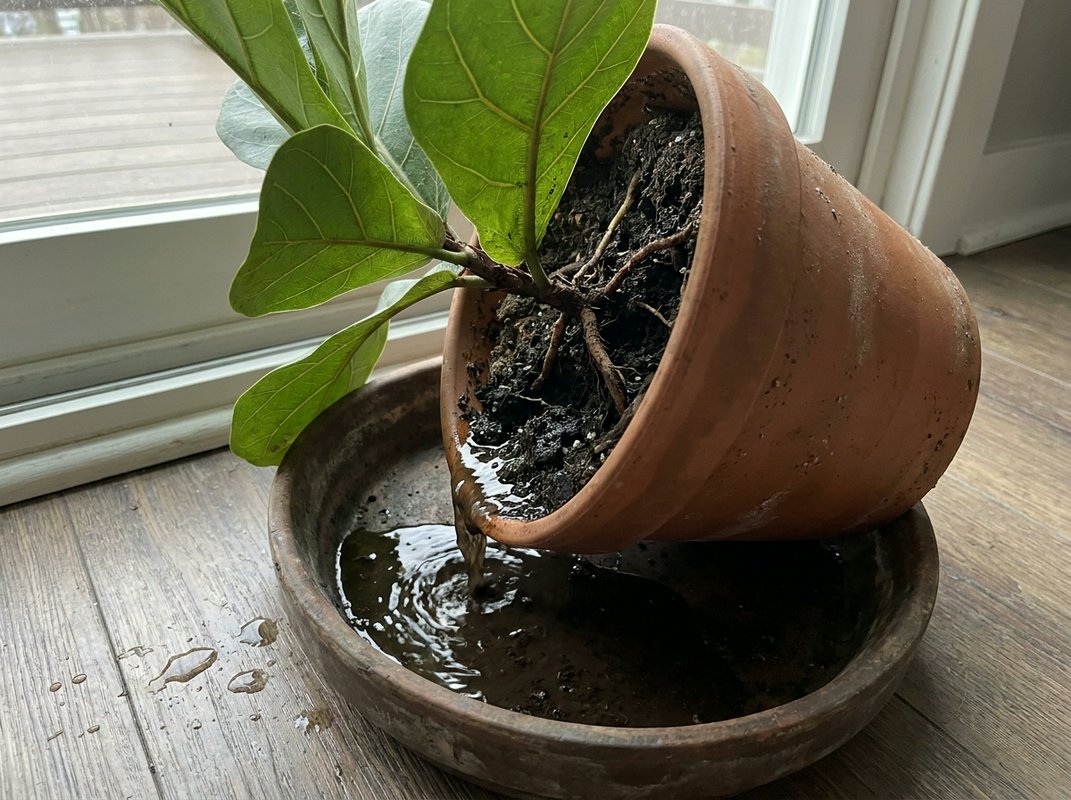
A fiddle leaf fig needs a pot with a drainage hole, and this is one of the few rules in this guide with no exceptions. Water that cannot escape sits around the roots, the roots sit in it for days, and they start to rot before a single leaf shows a sign of trouble. By the time the leaves do show something, the damage is usually well underway below the soil line.
The most common way this goes wrong is not a bad pot. It is a good plant put into a decorative pot with no hole in it, because the pot looked right in the shop and nobody thought to check underneath. Watered on the same schedule as everything else, it fills with water that has nowhere to go, and the plant declines over the following weeks for reasons that look, from the leaves, like almost anything else.
If a pot you want to use has no hole, keep the fiddle leaf fig in its original plastic grow pot and stand that inside the decorative one as a liner, lifting it out to water over a sink and letting it drain before it goes back in. The alternative is a pot that drains properly in the first place, sitting on a saucer to catch what comes through.
Fuller detail on fitting a liner, choosing a saucer, and adding drainage to a pot that was not built with it is covered in the guide to drainage for indoor planters. The question of what size that pot should be, for a fiddle leaf fig specifically, is its own subject and is covered separately.
Common problems: brown spots, leaf drop and repotting mistakes
A fiddle leaf fig that develops brown marks or drops leaves is telling you something specific about how it has been kept. The three most common causes point to opposite fixes, so it is worth reading the symptom properly before you change anything.
Brown spots: overwatering, underwatering or cold
Overwatering produces soft, brown-edged patches that often sit in the middle of a leaf, sometimes ringed with yellow, and the soil underneath stays damp for days after you last watered. Underwatering gives you dry, crisp brown that starts at the leaf tip or edge and works inward, usually alongside leaves that curl or droop before they discolour. Cold draughts mark the leaves nearest a window or an exterior door, producing brown or blackened patches that appear within a day or two of a cold snap.
Check the soil before you treat the leaf. Push a finger down 3–5 cm; if it is wet at that depth and the spots are soft, ease off watering and check the pot actually has a drainage hole the water can reach. If the soil is dry well below that depth, water thoroughly until it runs through the base. If the moisture looks fine and the marked leaves are the ones nearest the glass, move the plant a short distance back from the window, particularly overnight in winter.
Leaf drop after a move
Losing a handful of leaves within a few weeks of a move, a repot, or even a big swing in room temperature, is a stress response to the change in light or humidity. Fiddle leaf figs are known for reacting this way to disruption, and the drop usually slows and stops once the plant has settled into its new spot. Keep the watering routine the same through this period.
When not to repot
Don't repot a plant that is already dropping leaves or showing other signs of stress, since repotting disturbs the roots and adds a second stress on top of the first. Hold off straight after bringing one home too, and give it a few weeks to settle into its new light and watering pattern before changing the pot. Winter, when growth slows right down, is also the wrong time: repot once new leaves start appearing in spring, when the plant has the growth to recover from the root disturbance. For the drainage side of any of this, it is worth checking the pot itself against the scenarios covered in the drainage guide.