
Calathea care in a British home
Calathea needs more humidity than almost any other houseplant people keep indoors, and a centrally heated room in winter takes that away fast. This guide covers the humidity, watering, pot choice and brown-edge problems that come with growing one in the UK.
Why British winters dry out a calathea, and how to put the humidity back
A calathea comes from the understorey of a humid forest, where the air around it rarely drops much below 50% relative humidity, and most of the trouble UK owners run into traces back to that single fact. A British home, especially from October to March, is nothing like it.
What central heating does to the air
Turning the radiators on dries the air in a room the same way it dries washing on a rack. A living room that sits at a comfortable 45% humidity in October can fall to around 30% once the heating is running through January, and a calathea feels that drop within days. The leaf edges lose water faster than the roots can replace it, and the plant has no way to close that gap on its own.
Grouping plants together
Plants release moisture through their leaves as a matter of course, and a cluster of several pots creates a small pocket of air around them that stays damper than the room generally. Standing a calathea among other houseplants raises the humidity right at leaf level without you having to do anything once it's set up.
Pebble trays
A pebble tray is a shallow dish of water with pebbles sitting above the waterline, and the pot stands on the pebbles. As the water evaporates it humidifies the air immediately around the leaves, and keeping the pot clear of the waterline matters, because roots sitting in standing water will rot.
Bathroom placement
A bathroom with a shower used daily runs noticeably more humid than a living room, which makes it one of the better rooms in a house for a calathea, provided there's enough light near the window. Where the bathroom is windowless or the light is too dim, the humidity benefit doesn't outweigh what the plant loses in light, and it's worth weighing the two against each other.
A note on misting
Misting the leaves gives a brief lift in humidity around the plant, but it fades within an hour or so as the water dries, which makes it a top-up. Grouping, a pebble tray or a consistently humid room does the steadier work; misting is worth doing alongside one of those.
How often to water a calathea, and why not tap water
A calathea wants its compost kept gently moist the whole way through, never left to dry out and never left sitting in water. Push a finger into the top of the soil. If it still feels damp at 2 centimetres down, leave it, and if it has dried out to that depth, it is time to water.
Why consistency matters more than a fixed schedule
The roots are shallow and fine, built to draw up water steadily. Letting the compost dry out fully between waterings stresses the plant, while leaving it sitting wet does the same damage from the other direction, because waterlogged roots cannot take up oxygen and start to rot. In a centrally heated British home that usually means checking the pot every few days through autumn and winter.
Why tap water is worth avoiding
Calathea reacts to the chlorine and fluoride present in most British mains water, and the effect builds up in the compost over several waterings. Leaving a jug of tap water to stand overnight lets the chlorine evaporate off, but it does nothing for the fluoride, which is the more persistent of the two. Filtered water or collected rainwater avoids both, and is worth the extra step for a plant this particular about its water source.
How to water it
Water until it runs through the drainage hole and into the saucer, then tip the saucer out. That keeps the compost evenly damp without leaving the base of the pot waterlogged between waterings.
Why the pot it sits in matters as much as how often you water it
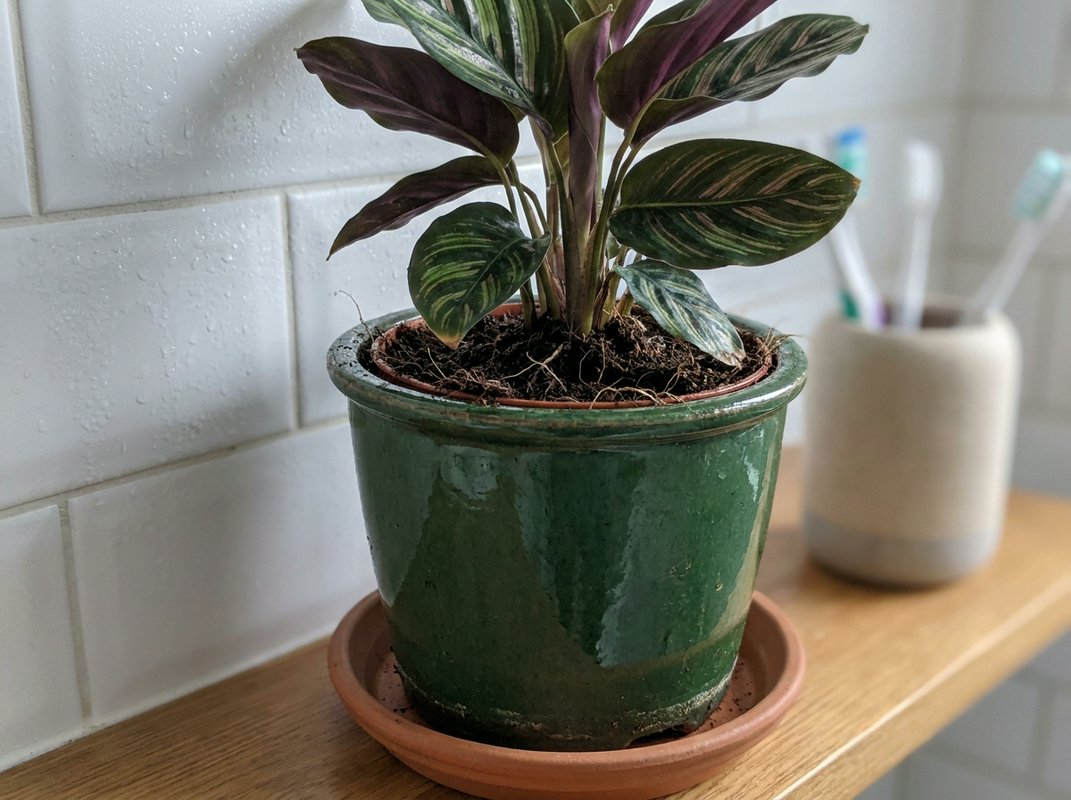
Terracotta is unglazed, so its walls are porous. Water moves through the clay and evaporates from the outside of the pot, not just from the soil surface, which is why terracotta dries out faster than anything glazed. For plants that like their soil to dry out between waterings, that's useful. A calathea isn't one of them: it wants the soil consistently moist, and a terracotta pot works against that aim every hour it's sitting in a centrally heated room.
In an unheated porch over summer, terracotta's quick drying is a minor inconvenience. In a heated British living room in January, it becomes a watering schedule you can't actually keep up with. A calathea in terracotta over winter will need water roughly every 3 to 4 days to stay ahead of what the pot is losing, against something closer to once a week for the same plant in a glazed or plastic pot. Most people don't water that often, and the plant tells you by crisping at the leaf edges before the soil even feels properly dry.
What holds moisture better
Glazed ceramic and plastic both work the same way here: the walls are sealed, so the only place water can leave is through the drainage hole or the soil surface. That means fewer top-ups and a much wider margin for the days you forget. A plastic nursery pot is the plainer option and does the job; a glazed ceramic outer pot does the same job and looks more deliberate on a shelf.
Either way, drainage still needs somewhere to go. A calathea sitting in standing water in a saucer is a different problem from a calathea drying out, and the two produce leaves that look almost identical until you check the soil.
Brown edges, curling leaves or yellow leaves: which problem do you have?
Calathea makes its complaints visible. The shape and colour of the leaf tell you which problem you are looking at, and mixing them up leads to the wrong fix: watering a plant that is already too wet, or misting one that is actually thirsty.
Crispy brown edges
The leaf margins turn brown and papery while the rest of the leaf stays green, often starting at the tip and working inward. This is a humidity problem. The air around the leaf is too dry for the time the plant can hold moisture at its edges, and no amount of extra watering reaches that part of the leaf to fix it. Moving the pot away from a radiator and raising the air moisture around it is what stops new leaves from doing the same thing.
Curling or rolled leaves
The leaves roll inward along their length, sometimes with a droop in the stem, and the whole plant looks smaller and tighter than usual. This is underwatering: the soil has dried out further than calathea tolerates, and the leaf curls to cut down the surface area losing water. Push a finger into the soil. If it is dry more than a couple of centimetres down, the plant needs water, and the curl should ease within a few days of the soil being kept consistently moist again.
Yellow leaves
Leaves turn yellow, often starting with the lower, older ones, and the stem at the base can feel soft. This is the pattern of overwatering, usually because the soil has stayed wet for too long between waterings or the pot is holding water with nowhere for it to drain. Check that the pot has a drainage hole and that water is not sitting in a saucer underneath it. Letting the top of the soil dry out properly before the next watering is what stops more leaves from going the same way.
Telling them apart
- Brown, crisp edges with the rest of the leaf green: air is too dry.
- Curled or rolled leaves with dry soil underneath: the plant needs water.
- Yellowing leaves, soft stem, wet soil underneath: the plant has had too much water or nowhere for it to go.
Checking the soil with a finger before reaching for the watering can or the mister is the quickest way to tell these apart, because the leaf symptoms alone can look similar at a glance.